The One-Surface Habit: How Clearing One Flat Surface Each Day Creates Visual Calm
Visual clutter is one of the quietest sources of daily stress. You may not notice it consciously, but a crowded kitchen counter, a dining table covered in mail, or a nightstand buried under books and cables sends a constant low-level signal to your brain that there is more to do. Over time, that signal makes it harder to relax, focus, or feel at ease in your own home. Instead of waiting for a free weekend to tackle everything at once, a smaller, steadier approach can create lasting change. The practice of decluttering one surface a day for a calmer home is simple, sustainable, and surprisingly powerful for restoring a sense of order and ease.
This habit does not require perfection, special organizers, or hours of sorting. It asks for just a few minutes of attention on a single flat area, allowing visual calm to build gradually without the exhaustion that often comes with large decluttering projects. By giving your eyes one clear place to rest each day, you begin to shift the overall feeling of your home from busy to balanced.
Why One Surface Is Enough to Change How a Room Feels
Flat surfaces are natural magnets for clutter. Because they are open and accessible, they collect the items we set down without thinking: keys, receipts, mugs, toys, chargers, and papers that have not yet found a home. When several surfaces are covered, the entire room can feel chaotic even if the rest of the space is relatively tidy.
Focusing on just one surface works because it respects both attention and energy. Psychologically, a single clear area provides a visual anchor. Your nervous system registers openness and order, which can lower feelings of overwhelm and make the space feel more spacious and intentional. Practically, a small daily win is easier to repeat than an ambitious overhaul. You avoid decision fatigue, you finish what you start, and you build momentum that carries into the next day.
How to Choose Your Daily Surface
The best surface to clear is the one you see most often or the one that bothers you the most. Start with areas that have the greatest visual impact, not necessarily the most cluttered drawer or closet. Ask yourself: where do my eyes land when I enter the room, and what surface makes me feel tense when it is messy?
Consider rotating through these common areas:
- Kitchen counter next to the stove or sink, where cooking and cleaning happen
- Dining table that often becomes a drop zone for mail and schoolwork
- Entryway table or console where keys, bags, and shoes accumulate
- Bathroom vanity that collects toiletries, cosmetics, and hair tools
- Nightstand that holds books, glasses, chargers, and water glasses
- Coffee table in the living room where remotes, magazines, and toys gather
- Desk or work surface where papers and devices pile up during the day
You do not need to follow a fixed order. Some people prefer to assign a surface to each day of the week, while others simply choose whatever feels most cluttered that morning. The key is to keep the choice light and flexible so the habit remains inviting rather than rigid.
The Five Minute Clearing Ritual
Set a gentle time boundary so the task stays calm and contained. Five to ten minutes is enough for most surfaces. Use a simple flow that you can repeat without thinking too much.
- Remove everything. Take all items off the surface and place them on a nearby bed, table, or floor. This reset lets you see the surface clearly and clean it if needed.
- Sort with intention. Quickly group items into four categories: stays, relocates, discards, and undecided. The stays are only what you use daily and love to see. Relocates belong elsewhere in the home. Discards are trash, recycling, or donations.
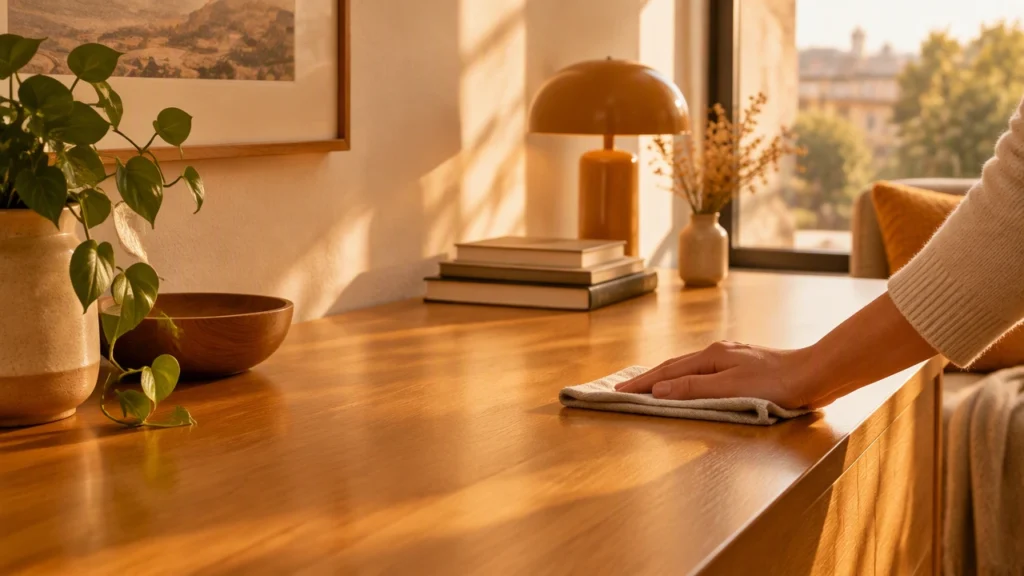
- Replace with care. Return only the stays, leaving generous open space. Aim for function and breathing room rather than decoration. A lamp, a plant, or a tray for essentials is often enough.
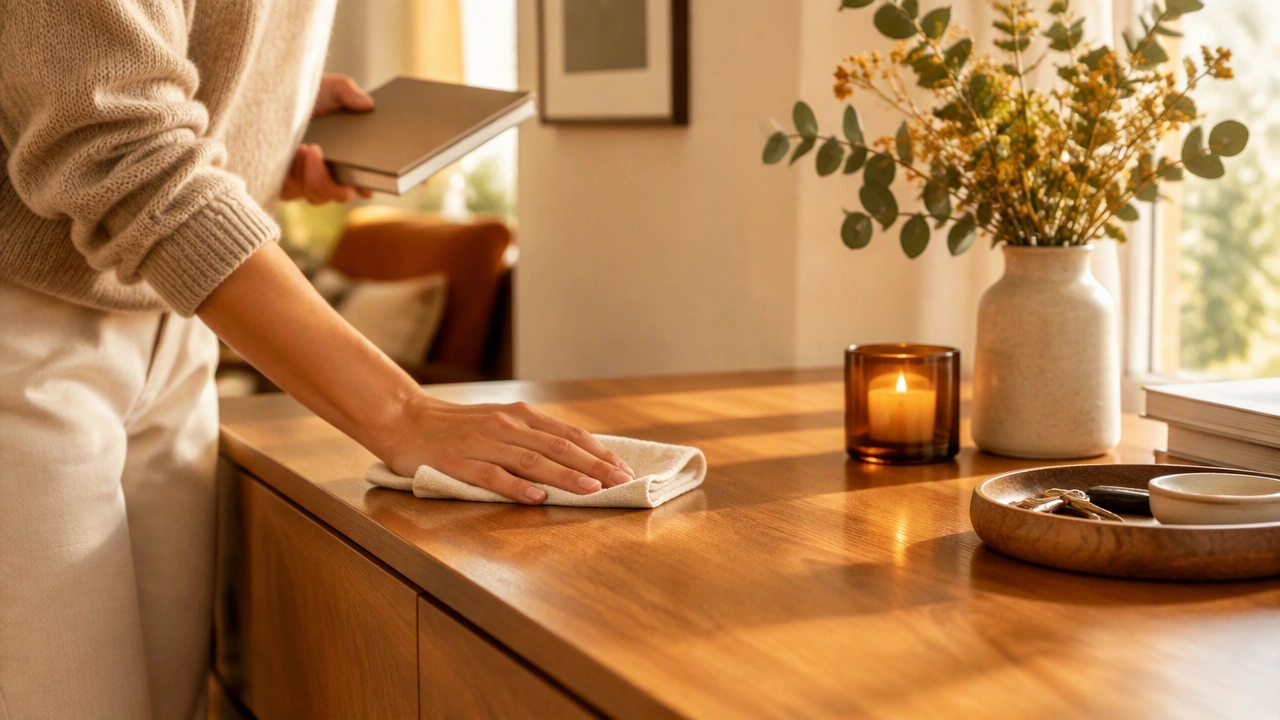
- Wipe and pause. Take thirty seconds to wipe the surface and then pause to notice the difference. This brief moment of appreciation helps your brain register the calm and reinforces the habit.
What to Do With What You Remove
Clearing a surface is only calming if the clutter does not simply migrate to another spot. Have a simple system for what leaves the surface so the rest of your home stays balanced.
- Relocate immediately for obvious items: return mugs to the kitchen, hang jackets, file papers in their designated place.
- Use a transition basket for items that belong in another room but cannot be put away right now. Empty the basket once a day, ideally in the evening.
- Create a donation bag that lives in a closet or laundry area. When it is full, take it out of the house without delay.
- Limit the undecided to five items or fewer. Revisit them within forty eight hours so they do not become a new source of clutter.
This follow-through prevents the habit from creating hidden piles and keeps the sense of calm intact.
Keeping Surfaces Clear After You Clear Them
A clear surface tends to stay clearer when you give everyday items a defined home nearby. Notice what repeatedly lands on the surface you just cleared and ask whether it needs a more convenient storage spot.
For example, if mail always covers the dining table, place a slim vertical sorter or a lidded box on a nearby shelf. If chargers tangle on the nightstand, add a small tray or cable clip to contain them. If toiletries crowd the vanity, use a single tray to group them and store extras inside a cabinet. These small adjustments reduce the friction of putting things away and make it easier to maintain visual calm.
Another helpful practice is a nightly reset of just one minute. Before bed, glance at the surface you cleared that morning and return any strays to their homes. This micro-reset protects your effort and lets you wake up to a calm starting point.
Building the Habit Without Pressure
Consistency matters more than intensity. To make the habit stick, link it to an existing routine rather than relying on motivation alone. You might clear a surface right after making morning coffee, after dinner, or before starting work. Pairing the action with a stable anchor helps it become automatic.
- Start small on purpose. If five minutes feels like too much, begin with three. Completing a tiny version of the habit builds confidence.
- Track gently. Mark a simple check on a calendar or keep a short list of surfaces you have cleared. Seeing progress is encouraging without needing an elaborate system.
- Allow skips. Missing a day does not erase your progress. Simply continue with the next surface when you are ready, without doubling up to compensate.
- Notice the feeling, not just the look. Pay attention to how the room feels to sit in, breathe in, or work in after the surface is clear. That felt sense of calm is the real reward.
Over time, you may find that you naturally begin to maintain more than one surface without effort. The habit trains your eye to appreciate open space and your hands to return things to their place. What begins as a deliberate daily practice slowly becomes a quiet way of caring for your home and your own sense of ease. By choosing one small area at a time, you create a home that feels lighter, clearer, and more restorative every day.